

 Marketplace
 login
login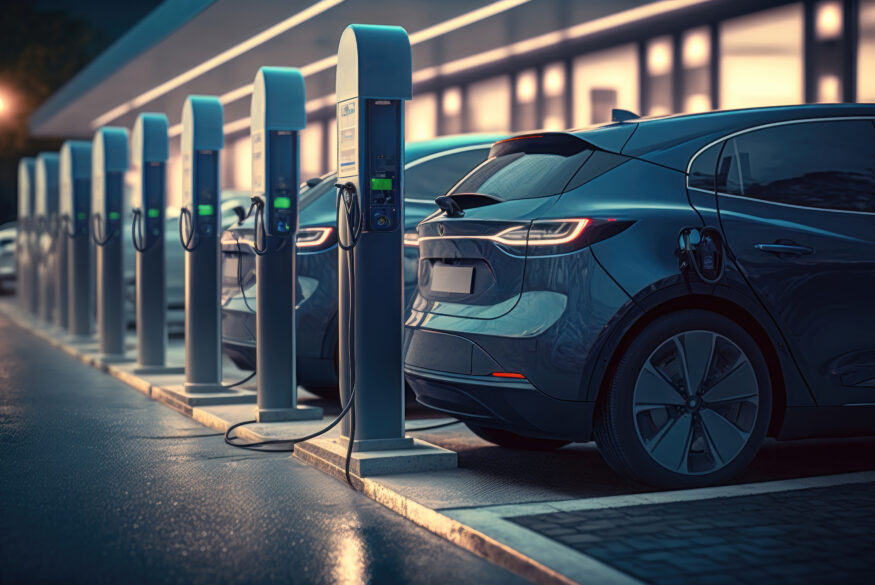
EV Charging Infrastructure: Getting Ahead of Tenant Demand


The New Baseline
EV charging stations in commercial parking decks were once a novelty and often promoted as unique amenities. Today, they are standard. CBRE reports that about 70% of the top U.S. office buildings now offer EV charging. According to a ChargePoint report, demand for workplace EV charging surged, with charging sessions rising 64% in 2023, compared to a 22% increase in active workplace charging ports. According to a ChargePoint report, total charging sessions increased by 34% over the past year, outpacing the 16% growth in new charging ports. Electric vehicle sales reached about 1.3 million units in 2024. That is a fourfold increase since 2019 and about 10% of new-vehicle sales. The Edison Electric Institute projects that over 78 million EVs will be on U.S. roads by 2035. This would mean more than a quarter of all vehicles. Employees and tenants are adopting EVs faster than most property owners anticipate.
The main question for building owners is no longer whether to provide EV charging, but how to meet tenant expectations without incurring unsustainable utility costs. The primary challenge is controlling electricity expenses associated with charging, not hardware selection.
I hope anyone installing EV Charging Infrastructure at their property understands and accounts for all the complexities in this article to end up with an amenity that meets all stakeholders’ expectations.
Start With What You Already Have: Assessing Electrical Capacity
Before choosing charging equipment, a building owner should know what the current electrical system can support. Most commercial buildings operate under utility rate structures similar to those used by major regulated providers. These are tiered by demand. Power and Light Small covers loads of up to 30 kW. Power and Light Medium is for 30 to 499 kW, and Power and Light Large is 500 kW or more. Where a building fits within this structure and how close it is to tier boundaries matter before adding new electrical loads.
A licensed engineer conducts an electrical capacity assessment by evaluating the service entrance, main switchgear, available panel space, transformer capacity and the building’s existing load profile. The engineer also calculates the load per the National Electrical Code, which governs EV charging installations under Article 625. The assessment identifies the existing capacity and the cost of upgrades if more capacity is needed.
The most cost-effective approach, when possible, is to install make-ready infrastructure while you complete other planned electrical work or renovations. Including conduit runs, pull boxes and stub-outs in bigger projects greatly reduces costs. In contrast, you will pay much more if you install these items as a standalone project, since it requires new trenching and disruptions to the parking area. If you run conduit to ten spaces—even without chargers—you can save tens of thousands of dollars later.
Choosing Equipment: Level 2 vs. DC Fast Charging
Commercial EV charging installations generally involve one of two technologies, and the choice between them has consequences that go far beyond charging speed.
Level 2 chargers operate on single-phase 208- to 240-volt power and typically deliver between 7 and 19 kilowatts per port. At that rate, a vehicle parked for a standard eight-hour workday will receive a full charge or very close to it. Level 2 is the appropriate solution for workplace settings where employees park all day. The equipment is widely compatible with virtually every EV on the market via the SAE J1772 connector standard, and installation costs per port are manageable, with equipment costs regularly ranging from $700 to $6,500 per connector, depending on the unit and its features.
DC fast chargers, also referred to as Level 3, operate at 480 volts on three-phase power and deliver anywhere from 50 to 350 kilowatts or more per session. They can bring most EV batteries from 20% to 80% charge in 20 to 40 minutes. That speed makes them appropriate for high-turnover retail environments, transit corridors and situations where drivers need a quick energy top-up rather than a full charge during a long dwell time. The equipment and installation costs are substantially higher, often ranging from $18,000 to more than $72,000 per charger, and they require three-phase electrical service and, in many cases, dedicated transformer capacity.
Networked chargers at either level include communication capabilities that enable the collection of usage data, access management, platform-based billing and intelligent load distribution across multiple ports. For any commercial installation where tenant billing or usage management is a goal, networked chargers are not optional. They are the basis upon which a dependable deployment is built.
The decision regarding charger capacities and the number of stations must balance the tenant EV charging demand and expected charging time.
The Part Most Building Owners Miss: Utility Rate Impact
This is where discussions often fail. Building owners install chargers and billing platforms, assuming the costs are passed directly to users. However, electricity costs at the charger differ significantly from the building’s utility bill, creating financial gaps.
Many utility rate structures employ a billing demand calculation, in which the per-kilowatt-hour rate charged to a building is determined not just by how much energy is consumed, but also by the rate at which it is consumed, expressed as peak demand in kilowatts. Billing demand is calculated using the current month’s peak and carried forward across the previous eleven months. Because large commercial buildings typically peak during the summer months, that peak demand extends throughout the entire annual billing cycle.
For example, a building with ten 10-kilowatt Level 2 chargers operating simultaneously at peak time increases its demand by 100 kilowatts. Under common medium-demand commercial tariffs, demand charges apply above certain thresholds, significantly increasing overall electricity costs.
Some utilities offer overnight or off-peak incentive rate plans during super off-peak hours from 11 p.m. to 7 a.m., which can help mitigate demand-related costs when charging is scheduled accordingly.
DC fast chargers make the situation more acute. One 150-kilowatt DC fast charger draws as much power as fifteen Level 2 units at full capacity. When several fast chargers run at once, their usage can quickly push a building into more expensive rate tiers. While expected regulatory changes may lower overall electricity rates, a building’s specific load profile and participation in Real Time Pricing still heavily influence actual costs.
“To avoid increased building electric rates, EVs need their own electrical infrastructure and customer costs must align with real-time pricing or actual rates,” said Chris Lelle with Lincoln Property Company.
If building managers do not synchronize EV charging stations with the building’s current Time of Use pricing signal from their utility provider, the building may pay a higher rate for the electricity consumed by chargers than it collects from users through its billing platform.
Programs like Georgia Power’s Overnight Advantage rate plan illustrate how utilities are attempting to address this challenge, offering lower electricity prices to customers who use more power during overnight hours. Incentives for EV chargers are based on the power rating, quantity and types of chargers installed. Building owners may benefit financially by planning for dedicated EV charging stations with eligible equipment.
Time-of-use, EV-specific rate plans have their own trade-offs. Beginning in January 2025, the TOU-EVC-4 rate will charge $0.298 per kilowatt-hour for energy used during on-peak hours, which are from 2:00 p.m. to 7:00 p.m., Monday through Friday, from June to September. A $152 monthly basic service fee is required, and in some markets, on-peak commercial EV rates can be significantly higher than standard residential rates. Because of this higher cost, even employees who own electric vehicles may use the building’s chargers only in emergencies.
“We don’t have a generation issue in America,” said Chris. “EV charging highlights our time of use issue, which drives energy demand and costs.”
This behavioral reality directly affects the return-on-investment projections that many building owners use to justify spending on EV charging infrastructure. Whether EV-specific rate plans are beneficial depends on factors such as the scale of the charging installation, the building’s current utility rate tier and the owner’s ability to shift charging to off-peak hours. In many states, time-of-use plans can significantly lower per-kWh costs if charging is done in those off-peak hours between 11 p.m. and 7 a.m. Dedicated meters and specific rate structures for EV charging can help clarify costs and simplify billing, but higher rates may also discourage use if they are not carefully considered. The best approach is to review the actual numbers for each situation before making a decision.
Tenant Surveys: Know Before You Commit
A report from NAIOP Magazine highlights that effective commercial EV charging planning requires a thorough understanding of the use case, site characteristics and business models before making infrastructure decisions. It establishes how many employees currently own EVs, identifies how many plan to acquire one within one to three years, gauges willingness to pay (the critical variable in any billing model) and creates a documented record that informs not only the financial model but also the design choices for charger type, quantity and location.
Buildings with few EV drivers may opt for phased installations with make-ready infrastructure, while those with tech or financial tenants may justify more aggressive deployment.
Surveys also provide an opportunity for honest communication with tenants about how the building plans to cover the cost of EV charging. When tenants understand the utility rate structure, the demand implications and the proposed pricing model, they are better prepared to make decisions about usage. A tenant who knows that charging between 2:00 p.m. and 7:00 p.m. on a summer weekday is expensive and has access to a charging platform that reflects that pricing in real time, will make different decisions than a tenant who has no visibility into the cost structure at all.
Cost-Sharing and Billing Models
There is no single correct model for sharing the cost of EV charging infrastructure and electricity between building owners and tenants, but several common approaches exist with distinct implications for risk allocation and revenue potential.
In the building-pays model, EV charging is offered as a free amenity included in common area maintenance charges or absorbed into the lease. This approach is simple to administer, avoids the complexity of per-session billing, and can serve as a tenant attraction and retention tool. The financial risk is that utilization is unpredictable, and if demand jumps unexpectedly, the building absorbs the full impact of the utility rate described above.
In the tenant-pays model, drivers are billed per kilowatt-hour or per session through a networked charging platform. This approach sets up a direct relationship between usage and cost recovery and is the most financially defensible. The challenge is that the billing rate charged to users must be calibrated to the utility rate the building pays, which, as discussed, is not a static number. Buildings operating under this model have to ensure the charging platform’s pricing engine is synchronized with the building’s applicable utility tariff, or they risk collecting less than they pay.
Revenue-sharing arrangements with third-party charging operators are increasingly common alternatives, particularly for building owners who want to offer charging without incurring capital expenditure or operational complexity. Under these models, a charging company installs, operates and services the equipment in exchange for a share of charging revenue or a monthly subscription fee. According to Facilities Dive, CBRE has partnered with EV+ to roll out electric vehicle charging systems at 10,000 commercial properties across the United States over the next five years. These models are worth careful evaluation because the terms vary widely, and the long-term economics depend heavily on utilization, which in turn depends on the charging rate.
On the incentive side, the Inflation Reduction Act provides a commercial tax credit for the purchase and installation of qualified EV charging equipment, and some states offer additional incentives, such as income tax credits of up to 10% of the cost or $2,500 per charger for eligible commercial installations. These incentives do not change the utility rate analysis, but they can meaningfully reduce the capital cost of deployment and should be factored into any project pro forma.
To stay up to date on news and resources such as this and other topics of importance to the real estate industry, subscribe to the free CRE Insight Journal Newsletter using this link.


Comments are closed.
Newsletter