
 Marketplace
 login
login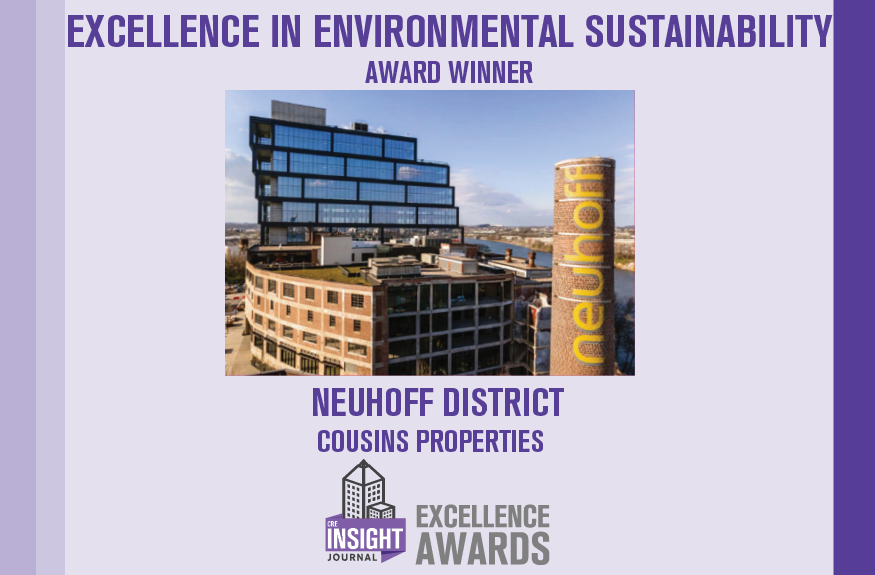
EXCELLENCE IN ENVIRONMENTAL SUSTAINABILITY: Neuhoff District


Neuhoff District, managed and owned by Cousins Properties, received the 2026 Excellence in Environmental Sustainability Award from CRE Insight Journal. The award recognizes a building that has recently undertaken significant environmental sustainability efforts or achieved long-term success in environmental sustainability.
Located at 1316 Adams St., along the west bank of the Cumberland River in Nashville, Tennessee, Neuhoff District brings together adaptive reuse, new construction, walkable mixed-use development and third-party sustainability standards.
The property’s environmental sustainability strategy begins with the site’s history. The Neuhoff Packing Company, a regional meatpacking operation established in 1905, helped shape the physical and economic character of Nashville’s Germantown neighborhood. Rather than demolishing the site’s century-old brick buildings, The development team at New City Properties retained and modernized them as The Curve, a five-story mixed-use building that now houses office and retail tenants.
By preserving large portions of the existing brick, structural steel, and concrete, the project reduced the need for new material use while maintaining a visible connection to Germantown’s industrial history.
Neuhoff District also includes Block 1, a 14-story Class A office tower designed for energy and resource efficiency. Together, the new tower and The Curve show two approaches to sustainable development: building new systems for long-term performance while extending the useful life of existing structures.
The district’s broader design also supports environmental sustainability goals through density and connectivity. Within a 14-acre footprint, Neuhoff District combines office, retail, dining, residential and hospitality uses. The district connects to the surrounding Germantown neighborhood and the Cumberland River Greenway, creating opportunities for walking, cycling and reduced reliance on vehicles.
What was once an inward-facing industrial property now includes pedestrian and bicycle connections that open the site to the river and surrounding community.
Neuhoff District’s environmental sustainability work is supported by third-party certification and operational tracking. Both primary buildings pursued LEED v4.1 Building Design and Construction: Core and Shell certification through the U.S. Green Building Council. Block 1 achieved LEED Gold certification, and The Curve achieved LEED Silver certification. Both certifications were awarded in May 2024.
The certifications reflect documented high performance across areas such as sustainable site planning, energy and water efficiency, responsible materials selection, and indoor air quality.
The district’s commitment to environmental sustainability continues through building operations. Both buildings are enrolled in the U.S. Environmental Protection Agency’s ENERGY STAR Portfolio Manager, and the property management team reviews performance through a monthly utility analysis process. That review tracks electricity consumption, peak demand, cost per square foot, greenhouse gas emissions, indoor water consumption, and related costs.
The environmental sustainability strategy continues inside the buildings through systems designed to monitor and adjust performance as occupancy changes. In Block 1, floor-by-floor air-handling units use variable frequency drives, direct digital controls, outside-air monitoring and high-efficiency filtration, while fan-powered terminal units are connected to the building management and control system. Lighting controls and occupancy sensors help manage electrical use, while leak detection is tied into the building controls for water-supplied mechanical and plumbing equipment. The building also requires BTU metering for tenant connections to the chilled water loop, giving the property team a way to track individual heat loads and better understand how tenant activity affects building performance.
Neuhoff District’s building systems were designed to support ongoing monitoring and adjustment. The Neuhoff District Team describes high-efficiency filtration, direct digital controls, outside-air monitoring, variable frequency drives, leak detection tied into the building management and control system, BTU metering for certain chilled water connections and lighting controls with occupancy sensors. Those systems give the management team data that can be used to adjust building performance as occupancy grows and tenants’ needs change.
Tenant participation is also built into the district’s environmental sustainability strategy. Tenant construction manuals for both Block 1 and The Curve include requirements for MERV 13 filtration, building-control-connected systems, leak detection, air balancing and commissioning. The requirements are reviewed during the construction approval process, so tenant spaces align with the buildings’ environmental sustainability performance goals from the start of occupancy.
Tenants are also encouraged to coordinate with the base building’s mechanical, electrical, plumbing and structural engineering teams during design. That coordination helps reduce conflicts, protect building systems and support more efficient buildouts.
Neuhoff District’s environmental sustainability work extends beyond the buildings themselves. A partnership with Earthworks, Inc. will give new purpose to recycled mulch created from wood collected after a February 2026 snowstorm. The material is planned for use in the Neuhoff District dog park, which is under development.
The district is also pursuing Fitwel certification for both buildings, which evaluates health-supportive design and operations. As occupancy stabilizes and more operational data becomes available, the Neuhoff District team is also positioning the district for future participation in the Global Real Estate Sustainability Benchmark, a global environmental, social, and governance (ESG) performance assessment framework for real estate.
Neuhoff District demonstrates how environmental sustainability can be integrated into a project at multiple levels: preserving existing structures, designing efficient new buildings, supporting walkable density, connecting to greenway infrastructure, setting standards for tenant construction, and tracking performance over time. The result is a redevelopment that honors the site’s past while creating a more connected, environmentally focused district for the future.
In recognition of its adaptive reuse, green building certifications, operational benchmarking and districtwide approach to environmental performance, Neuhoff District has received the 2026 Excellence in Environmental Sustainability Award from CRE Insight Journal.
“Big shout out to the Neuhoff Team, Matt Ferris (Chief Engineer), and Hannah Chandler (Administrative Manager) for their contributions to Neuhoff’s continued commitment to sustainability, operational excellence, and environmental performance,” said Deon White, Property Manager with Cousins Properties.
CRE Insight Journal is the leading, on-demand resource for real estate professionals. It features a rapidly growing collection of real estate industry insight recorded in articles, webinars, publications, and videos. The CRE Insight Journal Awards program recognizes excellence in companies, people and properties in the CRE industry.
Announcing Applications for the 2026 10 to Watch Program! CRE Insight Journal 10 to Watch recognizes the real estate industry’s top early career professionals. The awards program tells the stories of how emerging professionals are shaping the real estate industry through a variety of career pathways.
Applications close on September 25, 2026, and winners will be announced in November 2026. Will you apply? Learn more at https://creinsightjournal.com/ten-to-watch/.
To stay up to date on news and resources such as this and other topics of importance to the real estate industry, subscribe to the free CRE Insight Journal Newsletter using this link.


Comments are closed.