

 Marketplace
 login
login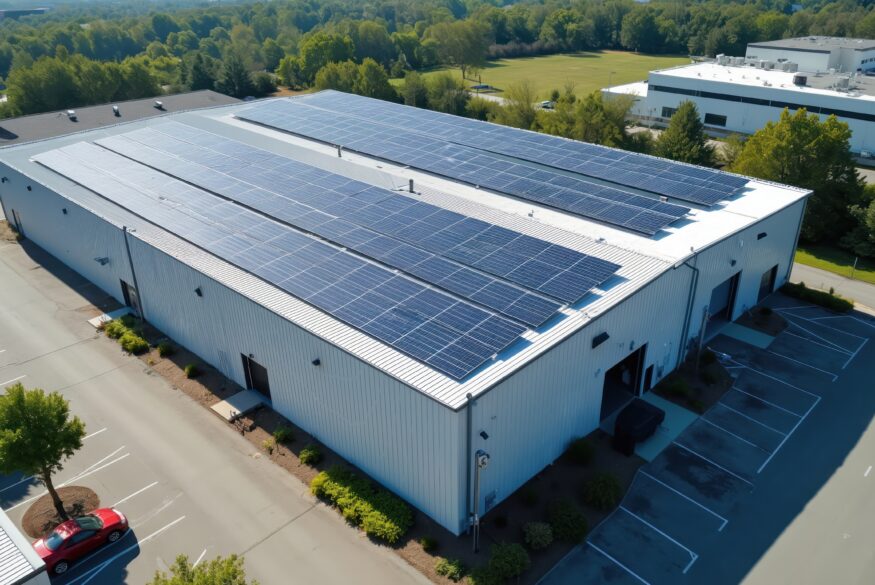
Industrial Real Estate and the Rise of On-Site Power


When the Warehouse Starts Making Its Own Power
For most of modern industrial real estate, electricity has been a utility expense. A warehouse connects to the grid, pays for the power it consumes and relies on that connection to keep operations moving. That arrangement is becoming more complicated as industrial buildings take on larger electrical loads and property owners look for ways to generate and manage power on site. Rooftop solar, battery storage, electric vehicle charging and microgrids are beginning to work together as parts of a single energy strategy, giving industrial properties new ways to produce and control electricity.
The change comes at a time when electricity demand across the United States is rising. The U.S. Energy Information Administration reported that electricity consumption reached a record 4.20 trillion kilowatt-hours in 2025 and expects demand to continue growing through 2026 and 2027. Data centers account for a significant share of projected growth, while manufacturing, transportation and other sectors are also increasing their use of electricity as equipment and processes become more electrified. For industrial property owners, these trends create a new set of considerations around the capacity, flexibility and potential value of a building’s electrical infrastructure.
More Power, More Places to Put It
Industrial properties have an advantage when it comes to distributed energy because many have expansive, relatively unobstructed roofs. Those roofs provide space for solar arrays that can generate electricity where it will be consumed, reducing the property’s reliance on electricity purchased from the grid during periods when the system is producing power. The growth of distributed solar has already established rooftop generation as a viable component of commercial properties. Berkeley Lab’s latest Tracking the Sun report counted approximately 5.3 million distributed solar systems installed in the United States through the end of 2025, including a substantial number of nonresidential installations.
Battery storage adds another dimension because electricity generated on the property does not have to be used at the exact moment it is produced. A battery can charge while solar generation is high and discharge later when the building’s equipment requires more power. Depending on the property’s utility rate structure and energy profile, that flexibility can help manage demand charges, shift consumption and provide another source of power during an outage. For an industrial property with substantial and predictable electrical loads, the combination of generation and storage can become part of a broader strategy for managing how and when the building draws electricity from the grid.
Industrial Loads Are Changing
A warehouse built around conventional lighting, refrigeration and material-handling equipment can have a very different electrical profile from a facility operating sophisticated automation. Robotics, automated storage systems, advanced manufacturing equipment and large-scale refrigeration can all increase demand, while electric vehicle fleets introduce another significant load when multiple vehicles need to charge during the same period. The result is a more complicated relationship between the building’s electrical capacity and the tenant’s operations, particularly when a company expects its energy requirements to grow over the life of its lease.
That creates a planning challenge for both tenants and owners. A property may have enough electrical capacity for its current occupant while lacking the capacity needed for the occupant’s next phase of growth, and obtaining additional utility service can involve substantial infrastructure upgrades and long lead times. Power availability is therefore becoming another consideration in industrial site selection and development, alongside transportation access, labor availability, building specifications and operating costs. A well-located facility may still face limitations if its electrical service cannot support the equipment a tenant expects to install.
The issue is especially visible in markets experiencing rapid growth in data centers and other large electricity users. The EIA expects electricity demand to continue increasing over the coming years, with data centers contributing significantly to commercial-sector growth while industrial and transportation electrification add demand elsewhere. As competition for available capacity increases in some markets, industrial properties with additional options for generating or managing power may have an advantage when tenants are evaluating locations.
Microgrids Bring the Pieces Together
A microgrid can bring several of these technologies together by combining solar generation, battery storage, conventional backup generation and an energy management system. Rather than relying entirely on a utility connection, a facility can coordinate multiple sources of electricity and manage when different sources are used. The approach can be particularly useful when a property needs more power than the local grid can readily provide or when maintaining operations during an outage is important.
One example comes from Prologis’ logistics facility in Almere, Netherlands. The site faced a grid connection limited to 55 kilowatts, far below the approximately 400 kilowatts needed for the facility’s operations. Prologis developed a microgrid incorporating rooftop solar, battery storage, backup generation and an energy management system to increase the site’s available power without waiting for a larger grid connection. The project illustrates how distributed energy can address an immediate real estate constraint while also giving the property greater control over its power supply.
Similar approaches are beginning to appear in the United States, particularly where logistics operations are adding electric vehicles. Prologis has developed an electric truck charging facility in Southern California that combines charging infrastructure with a microgrid using renewable energy and battery storage. The facility is designed to support charging for up to 96 electric trucks simultaneously. For logistics properties, the combination is particularly relevant because the warehouse and the transportation operation increasingly share the same energy requirements. A facility can consume electricity to operate its building systems, charge its vehicles and support increasingly automated material handling, making energy planning a consideration that extends well beyond the building’s walls.
The Roof, Parking Lot and Electrical Room Become Connected
These developments also change how property teams may approach capital planning because energy infrastructure increasingly crosses traditional building-system boundaries. A solar array affects the roof, battery storage requires appropriate space and electrical connections, fleet charging affects the property’s electrical distribution system and parking or loading areas, and a microgrid requires controls that coordinate multiple sources and loads. Planning these components separately can make it harder to understand how they will interact once the systems are operating together.
A property considering a major electrical upgrade, for example, may want to evaluate whether additional capacity could eventually support vehicle charging or automation. An owner planning a roof replacement could consider whether the roof’s design and remaining service life make it a candidate for future solar installation, while a tenant expanding its electric fleet may need to understand whether the building’s existing electrical service can support simultaneous charging. Looking at those possibilities during capital planning can give owners more options than waiting until a tenant’s needs have already outgrown the property’s infrastructure.
A New Asset to Manage
For property managers and building engineers, distributed energy also introduces equipment and systems that require ongoing attention. Solar panels need inspection and maintenance, batteries have their own monitoring and safety requirements, and charging equipment can create additional service needs. Microgrids depend on controls that coordinate multiple sources and loads, which means property teams may need to understand how these systems interact with conventional electrical equipment and how responsibilities are divided among owners, tenants, utilities and contractors.
The additional systems can also produce useful operational information. Energy management platforms can provide data about generation, storage, consumption and demand, giving owners a more detailed picture of how a property uses electricity throughout the day. Over time, that information can help property teams identify operating patterns, evaluate equipment performance and make more informed decisions about future capacity and capital improvements. The energy system becomes something that can be monitored and managed rather than simply billed as a monthly expense.
The Industrial Property as an Energy Asset
Not every warehouse will become a self-sufficient power system, and the economics of solar, storage and microgrids vary considerably by property. Roof condition, utility rates, available incentives, electrical capacity, tenant demand and local regulations all influence whether a project makes sense. The broader trend is still worth watching because industrial buildings have characteristics that make them particularly well suited to distributed energy, including large roofs, substantial electrical loads and growing demand for vehicle charging and automation.
The shift gives owners another way to think about the infrastructure that supports an industrial property. Electrical capacity has traditionally been evaluated primarily in terms of whether the building has enough power to serve its current use. Increasingly, owners can consider whether that infrastructure gives the property enough flexibility to accommodate the next tenant, the next piece of equipment or the next stage of electrification. That flexibility may become increasingly valuable as tenants place greater demands on their facilities and utilities face their own capacity constraints.
A warehouse that can generate electricity during the day, store some of it for later use, support an electric fleet and manage its demand has a different relationship with the grid than a conventional facility. As electricity demand continues to rise, industrial real estate has an opportunity to become an active participant in meeting that demand. The warehouse will continue to be a place where goods are stored and moved, but its roof, electrical infrastructure, parking areas and energy systems may increasingly work together to make the property a source, storage point and management center for power.
To stay up to date on news and resources such as this and other topics of importance to the real estate industry, subscribe to the free CRE Insight Journal Newsletter using this link.


Comments are closed.